
A wrong site or territory decision is expensive, political and hard to unwind.
Build one repeatable spatial decision framework so property, finance and franchise teams can assess opportunities, understand trade-offs and stand behind the call.
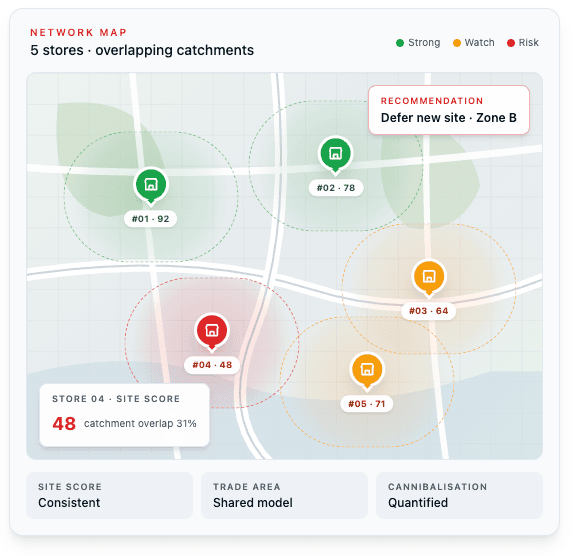
FRICTION POINTS
Where network decisions break down
Every expansion decision starts from scratch.
When the methodology lives in people rather than systems, the logic leaves with them. Each new market, site or territory decision becomes harder to compare, repeat and defend.
Your catchment data means different things to different teams.
Property is working from one model. Marketing from another. Finance from a third. By the time a site decision reaches the table, half the meeting is spent reconciling the numbers rather than making the call.
Territory boundaries were drawn years ago and the market has moved.
Franchise agreements defined territories based on postcodes or rough radius measurements that made sense at the time. They do not reflect how customers actually move, where competitors have opened or what the catchment can now support.
Cannibalisation risk is a number you need before you sign, not after.
When a new site affects an existing franchisee's trade area, you need a defensible spatial analysis to back the decision. Gut feel and a map on a screen will not be enough when a franchisee pushes back.
The real issue sits beyond GIS. It is about building a reliable decision-making framework across the business. The retailers and franchise networks pulling ahead are not the ones with better mapping software. They are the ones that have replaced ad hoc analysis with a consistent spatial framework. It produces the same answer regardless of who is running it, holds up to internal scrutiny and gives franchisees something they can see and trust.
WHAT CHANGES
From ad hoc analysis to a consistent spatial framework.
BEFORE
AFTER
| Site selection methodology in people's heads, rebuilt every time someone leaves. | A repeatable scoring framework applied consistently across every market and owned by the business, not the analyst. |
| Three catchment tools, three methodologies, no single number everyone agrees on. | One trade area definition across the network, giving property, marketing and finance the same spatial view. |
| Territory boundaries based on postcodes that no longer reflect customer movement. | Territories defined by actual catchment data that can be defended to franchisees and updated as the market changes. |
| Cannibalisation analysis done case by case, inconsistently, after someone complains. | Impact assessment built into the site evaluation process so the answer is ready before the question is asked. |
| Performance measured against last year, not against what the catchment can support. | Every store benchmarked against its spatial opportunity, revealing which locations are underperforming relative to their market rather than simply against their own history. |
For 30 years, we have built the spatial data foundations behind complex, high-stakes decisions.
That work requires consistent methodologies, reliable analysis and answers that hold up when challenged by people with different priorities. We bring the same discipline to the decisions shaping your store and franchise network.
TELL US ABOUT YOUR NETWORK
Tell us about your network and we will identify where stronger spatial data can bring greater consistency and confidence to your decisions.
We will review the data, tools and methodology behind your current decisions, then identify where greater consistency or clarity may be needed.
No pitch deck. No sales sequence. Just a conversation.